California Specific Antimicrobial Drug Laws Pertaining to Livestock.
California Senate Bill 27. What is it?
On Saturday, Oct. 10, 2015, California Gov. Jerry Brown signed Senate Bill 27. The bill is similar in most regards to the federal regulations on the judicious use of Medically Important Antimicrobial (MIA) drugs in food-producing animals outlined in GFI 209 and 213 (see VFDs more details). Antibiotics that are deemed important for use in human medicine will be restricted to use in livestock for therapeutic purposes only and by prescription from a veterinarian.
The bill specifies when an MIA drug may be used:
It also will require the California Department of Food and Agriculture (CDFA) to gather information on MIA drug sales and usage, antimicrobial resistant bacteria, and livestock management practice data.
The bill specifies when an MIA drug may be used:
- Necessary to treat a disease or infection
- Necessary to control the spread of a disease or infection
- Necessary in relation to surgery or medical procedure
- When in the professional judgement of a licensed veterinarian, it is needed for prophylaxis to address an elevated risk of contraction of a particular disease or infection
- Shall not administer an MIA to livestock solely for the purpose of promoting weight gain or improving feed efficiency.
- Unless the administration is consistent with 1-3, a person shall not administer a MIA in a regular pattern.
It also will require the California Department of Food and Agriculture (CDFA) to gather information on MIA drug sales and usage, antimicrobial resistant bacteria, and livestock management practice data.
Food And Agricultural Code Division 7:
•Chapter 4.5: Livestock: Use of Antimicrobial Drugs (Section 14400-14408)
•Chapter 4: Livestock Drugs (Section 14200-14390)
•Chapter 6: Commercial Feed (Section 14901-15103)
•Chapter 4.5: Livestock: Use of Antimicrobial Drugs (Section 14400-14408)
•Chapter 4: Livestock Drugs (Section 14200-14390)
•Chapter 6: Commercial Feed (Section 14901-15103)
Sections of Interest: Chapter 4.5: Livestock: Use of Antimicrobial Drugs.
Section 14401: Medically important antimicrobials (MIAs) require prescription or VFD from a licensed veterinarian with a VCPR that meets the requirements of Section 2032.1 of Title 16 of the California Code of Regulations.
Section 14402: Allowable conditions for use.
Section 14403: Accessibility to MIA's through licensed retailers.
Section 14404: Antimicrobial stewardship guidelines and best management practices.
CDFA has authority to fine violators unless they are licensed veterinarians.
•California Veterinary Medical Board will determine if a veterinarian is in violation and appropriate
disciplinary action on a case by case basis.
Section 14402: Allowable conditions for use.
Section 14403: Accessibility to MIA's through licensed retailers.
Section 14404: Antimicrobial stewardship guidelines and best management practices.
CDFA has authority to fine violators unless they are licensed veterinarians.
•California Veterinary Medical Board will determine if a veterinarian is in violation and appropriate
disciplinary action on a case by case basis.
Business and Professions Code Division 2:
•Chapter 11: Veterinary Medicine (Section 4800-4917)
•Chapter 9: Pharmacy (Section 4000-4426)
•Chapter 11: Veterinary Medicine (Section 4800-4917)
•Chapter 9: Pharmacy (Section 4000-4426)
California Regulations: Veterinary Client Patient Relationship (VCPR)- 16 CCR 2032.1
A VCPR is established when the client has authorized the licensed veterinarian to assume responsibility for making medical judgements and the need for medical treatment of the patient (including the prescription of antimicrobials) AND the veterinarian has agreed to assume that responsibility and has communicated with the client an appropriate course of treatment.
For a valid VCPR, the veterinarian must be personally familiar with the care of the animal(s) by way of an examination of the animal or by medically appropriate and timely visits to the premises where the animals are kept AND have enough knowledge of the animal(s) to give at least a general or preliminary diagnosis of the medical condition.
For a valid VCPR, the veterinarian must be personally familiar with the care of the animal(s) by way of an examination of the animal or by medically appropriate and timely visits to the premises where the animals are kept AND have enough knowledge of the animal(s) to give at least a general or preliminary diagnosis of the medical condition.
Antimicrobial Use in CA Livestock. A presentation about California Senate Bill 27 and the AUS program. If you are giving a presentation and would like to use these slides, please contact CDFA_AUS@cdfa.ca.gov.

|
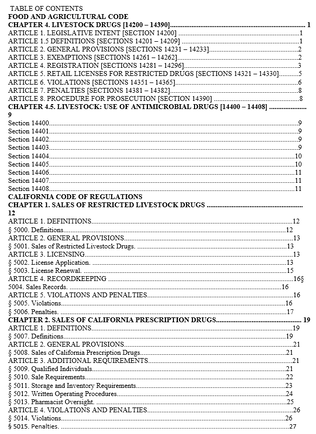
Livestock Drug Laws and Regulations
| ||||